Overview
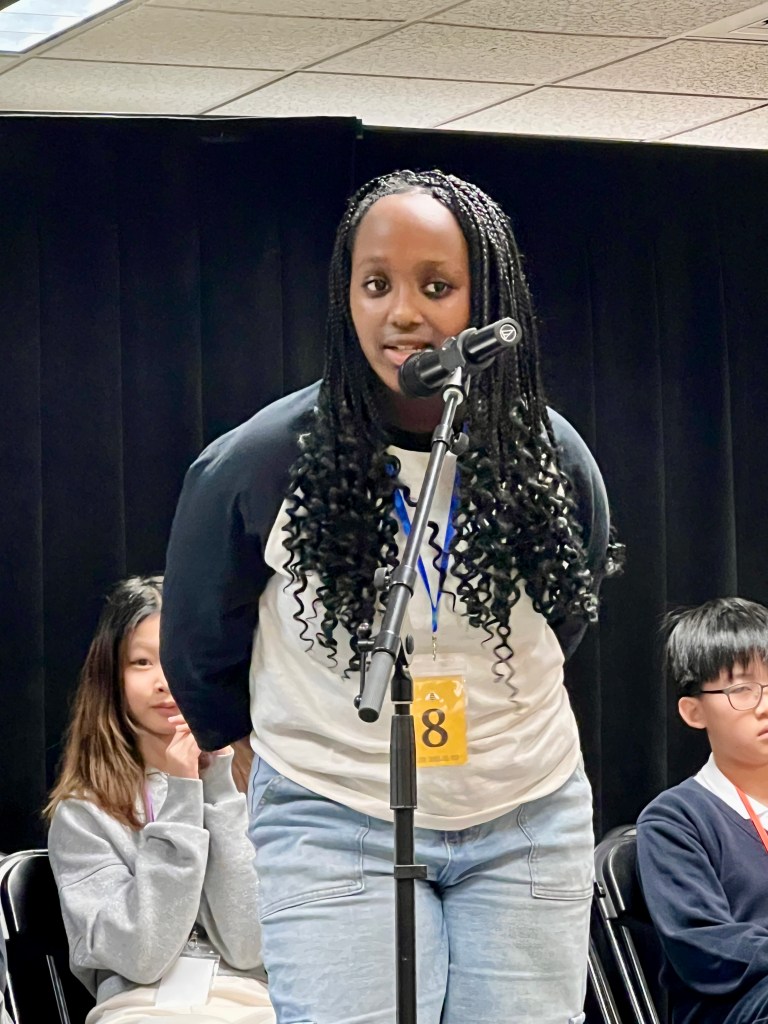
The L.E.S.T. Spelling Bee is conducted in four divisions, one each for 5th, 6th, 7th, and 8th grade. Awards will be given to the top finishers in each division.
Details
Each school is permitted to enter one student representative and one alternate for each grade level. Spelling lists are not published or distributed by L.E.S.T. Northwest. It is suggested that schools help their student representatives find word lists with which to practice from their school spelling curriculum or through websites designed to help students prepare for Spelling Bees.
All teams must be pre-registered by the deadline. Registration details and deadlines are found on the Registration Page.
There will NOT be a written qualifying test prior to the oral spelling competition. Each of the grade level participants from each school will compete in the oral spelling bee. Alternates will only participate if the main speller is unable to participate in the spelling bee.
Specific guidelines for the spelling bee, including the procedure to follow once only two spellers remain, are included below.
The Spelling Bee is meant to be a form of friendly competition. The students are striving to do their best and to gain confidence in front of an audience. The audience should be reminded that their only function is to provide positive support for the event. All decisions of the lead adjudicator are final.
Specific Rules for Spelling Competition
The format for the Spelling Bee will be as follows:
- The competition will be an oral spelling bee.
- The information of THIS bullet point is being reviewed and is likely to change prior to the 2027 tournament: The first three (3) rounds will take place before anyone is disqualified. The adjudicators(s) will keep track of spelling errors from the first three rounds and at the end of the third round, spellers who have any spelling errors from the first 3 rounds will be disqualified.
- The word will be pronounced according to the diacritical markings in Webster’s Third New International Dictionary (unabridged). The word will then be used in a sentence, and it will be pronounced again.
- The participant will say the word, spell the word, and say the word again.
- Adjudicators may not disqualify a speller for failing to pronounce a word either before or after the spelling.
- If the word is not spoken by the student after spelling the word, the student will be asked to say the word and then the adjudicator will make the determination of whether the word has been spelled correctly.
- If the student feels they have made a mistake, they may request to “start over,” but must repeat EXACTLY what was already spoken. If letters or their sequence are changed in the respelling, the speller will be eliminated.
- REGARDING SPELLING BEE ROUNDS:
- The spelling bee is conducted in rounds.
- A contestant is allowed only 30 seconds to spell a word. The adjudicators may disqualify any contestant who ignores a request to start spelling.
- Upon missing the spelling of a word, the speller will walk to a designated area. If any of the remaining spellers spell their words correctly, then the spellers who missed their words will sit down at the end of the round.
- If none of the spellers remaining in the bee at the start of a round spells a word correctly during the round, all spellers will remain in the contest. All of the spellers eliminated in the same round will be tied for the same place.
- Rounds continue until only one speller spells their word correctly.
- If, at the end of a round, only ONE speller has spelled their word correctly, then a new, one-word round begins. The speller will be given the opportunity to spell a word (anticipated championship word). If they are successful, the speller is named champion, and all of the other spellers from the previous round will earn second place. If the speller misspells the anticipated championship word, a new round will begin with all of the spellers from the previous round. Spellers continue to spell in the same order as before.
- Adjudicators’ decisions will be final.
- If more than one spelling is listed for a word in the official Webster’s Dictionary, any of these spellings shall be accepted as correct if the word either matches the pronunciation and definition provided by the pronouncer, or if it is clearly identified as being a standard variant of the word the contestant has been asked to spell. If a word has one or more homonyms, the pronouncer will indicate which word is to be spelled.
- Any questions relating to the spelling of a word must be referred to the judges immediately by the speller or the speller’s coach before completion of the round in progress. No protest can be entertained after a round is completed. Only contestants or their coach may question the spelling of a word. The judges are in control and their decision is final in all situations.
- Contestants and their families/supporters should remain seated until the end of the grade level competition. It is very distracting to the contestants when people enter or exit the room during the competition.
To eliminate any doubt about winners in any round, all contestants will be given a number at random to wear, and these numbers will be tracked through each round. This will allow for more than one person to “tie” for a place if several contestants go out in the same round.
Again, please remember that this is to be a form of friendly competition. The students are striving to do their best and to gain confidence in front of an audience. The audience has one function, which is to provide positive support for the event. The decisions of the adjudicators are final.
Role of the Pronouncer
- Clearly pronounce each word.
- If a word has one or more homonyms, define the word.
- Respond to speller requests for definition, sentence, part of speech, language of origin, and alternate pronunciation as needed. (Does NOT discuss root words, provide alternate definitions, or slow down pronunciation.)
Role of the Adjudicators
- Uphold the rules of the competition and decide whether or not a word has been spelled correctly.
- Sit in sight of the spellers so that lip movements can be observed while spelling.
- Make sure that all participants know the rules at the beginning of the competition.
- Assist the pronouncer in helping the speller to understand the word.
- Listen closely to the speller’s pronunciation of the word prior to spelling to make sure they understand what word is being spelled.
- Correct pronunciation of the pronouncer as needed.
- Determine disqualification for reasons other than misspelling: poor sportsmanship, or altering the letters or sequence during a respelling.
 LEST Northwest