Goals for All Forensic Competition
Our Forensic events are designed to promote intellectual growth through friendly competition and positive educational experiences and opportunities. The goal for each participant and coach is to learn, to grow, to exercise and share skills and abilities in a courteous, polished manner.
All participants, observers, and coaches are expected to observe the general principles and concepts of:
- Ethical behavior
- Appropriate demeanor
- Proper decorum
- Honest and original best efforts
- Free interchange of ideas
The aims and responsibilities of a speech and drama coach are to guide the intellectual development of the speakers to promote and provide opportunities for them to develop their skills, as well as to engender good sportsmanship, fair play and individual integrity. The coach is not a speech writer or a theatrical designer. The coach is primarily an educator.
The following practices are considered unethical and pedagogically unsound and are not condoned:
- The altering of material in interpretive events that is contrary to the author’s intent.
- The writing of speeches and introductions by anyone other than the student(s).
- The use of canned (i.e. re-use of previously prepared) speeches for original oration.
- The use of emotional appeals without the evidence to support them.
- The distortion or falsification of evidence.
- The breaching of normal courtesy by heckling, grimacing, or loud whispering while another student is speaking or performing.
- The use of the same material in two different years by the same individual.
Description / Regulations
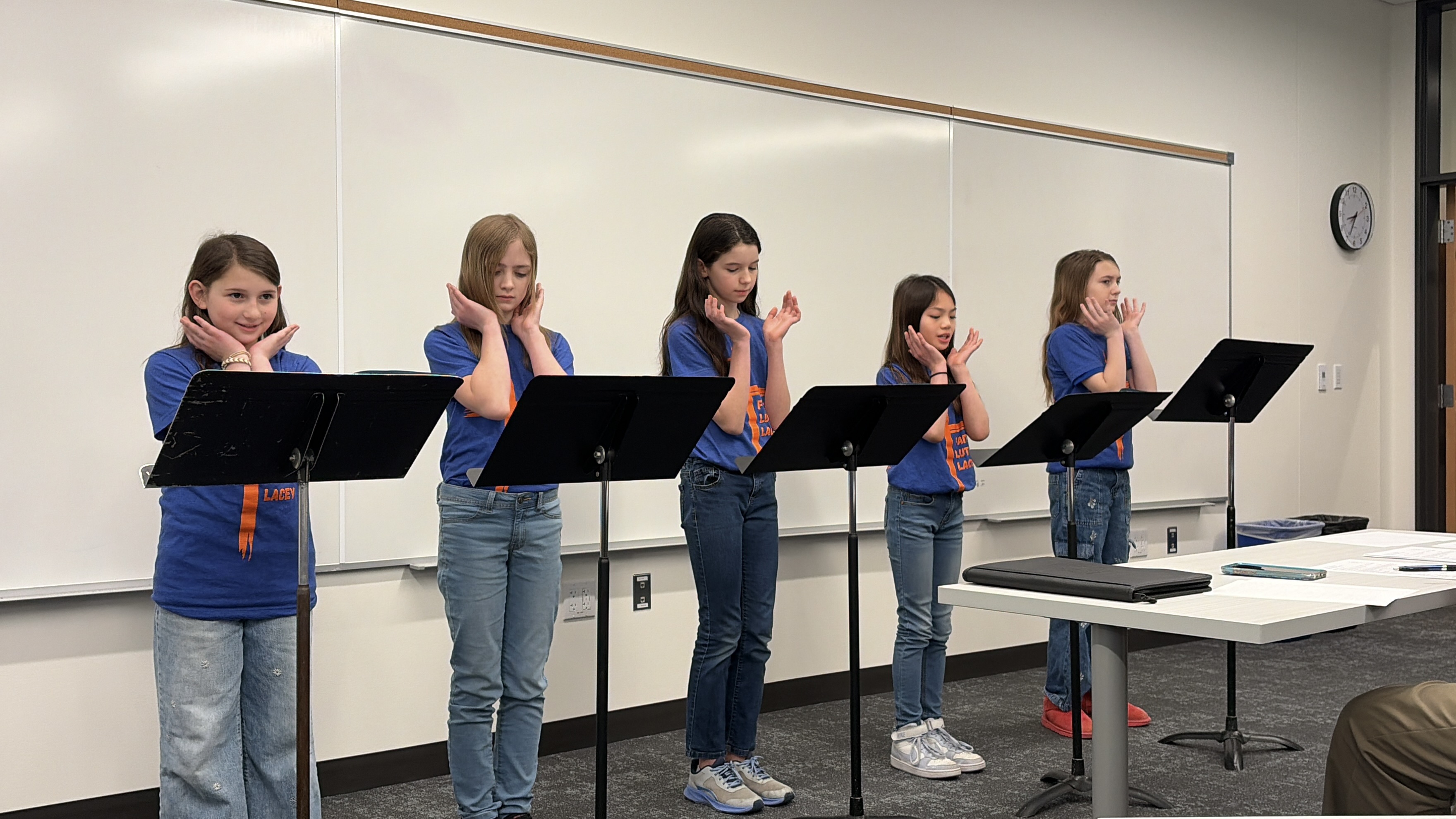
Twelve minutes maximum (there is no minimum). Readers’ Theatre is a group presentation in which an open script must be used, either in hand or on a lectern. Each performance group may be as few as three (3) and as many as six (6) readers. Each school may enter up to three teams, one with any combination of 5th and 6th Grade students, and two with no grade restrictions, any combinations of students from 5th through 8th grade. It is even allowable for only 5th or 6th graders to read as part of the “any grade” category, though they may face considerable disadvantage performing in a category where other teams include 7th and 8th Graders.
A Readers’ Theatre script may be drawn from any form of literature, poetry, or prose. Acceptable sources must be generally available to the public. Examples of acceptable sources include published and printed novels, short stories, plays, screen plays or poetry. Audio/video recorded material that is not printed and published is not an acceptable source. Adaptations of the original source material may be for the purpose of continuity only. During the presentation a reader must name the author and source from which the selection was drawn.
The content of Readers’ Theatre pieces may be dramatic and serious in nature, or sentimental and touching, but they also may be humorous. In fact, this style of forensic competition is ideally designed for entertaining through humor. Students should select pieces that are appropriate for them. Considerations for selecting a Readers’ Theatre piece should include the students’ ages, maturity, and the ethos of Lutheran Schools.
No costumes are allowed; students are encouraged to dress in a color theme (all black, all blue jackets, etc.). Dressing in school “bling” (sweatshirts, T-shirts, etc. with school logo/mascot etc., special school L.E.S.T. Northwest apparel) is another encouraged option. Readers may move no further than three feet from their original position. This includes turning; a common technique in Readers’ Theatre is having readers turn their back to the judges/audience when not in the scene. Readers may not touch each other. Upper body gestures are allowed, and facial expressions are essential (although intentional lack of expression may have its place). No props may be used. Sound effects are limited to those sounds that performers may make with their own bodies, scripts or stands. Different styles exist for Readers’ Theatre. Adjudicators shall attempt not to penalize competitors for their choice of presentation style.
Readers’ Theatre is an audience-focused interpretive event. At no time are readers to make eye contact with each other. Rather, they should look out toward the audience, as if the person they are speaking to is out in front of them rather than standing beside them. Eye focus may shift to different locations out in front to indicate a reader is looking between multiple individuals, but they may never actually physically look at each other.
Selecting / Cutting a Competition Piece
Finding competition pieces can be one of the most difficult parts of Readers’ Theatre. There are so many potential pieces, and everyone wants to find the right one. One of the most important things to remember is for the readers to find a selection that speaks to them. They should enjoy the piece, and it should fit their aesthetic and make sense to them. Each team should seek a story that they will enjoy bringing to life. Coaches may play a critical role in guiding teams to competition pieces, but the final decision of what piece to perform should rest with the readers themselves.
There are billions of potential pieces out there across various types of mediums. The best pieces are always going to be found by reading. Short stories, poems, novels, children’s books, mysteries, plays, musicals, essays – all are excellent sources for Readers’ Theatre. While novels and short stories are often adapted for Readers’ Theatre, when first trying the event the simplest route is often to draw from a play or musical, something written for stage performance. If adapting from a literary source, look for literature that:
- is interesting or has compelling content.
- has a strong story line, interesting characters, conflict, plot action, humor.
- uses dialogue.
- is not filled with descriptive passages.
- flows at a steady pace.
Keep in mind not all sources may be appropriate content for a Lutheran School competition.
Adjudication
One or two adjudicators will score each team (if two, their scores are averaged), giving up to 100 points based upon how appropriately the readers follows the rules of RT as well as meet the following performance elements:
- Reads with expression, proper emphasis, and clear enunciation, using voices effectively to convey meaning.
- Uses blocking effectively within the limits of Readers’ Theatre rules.
- Projects to the audience.
- Is familiar with the part and can read it with fluency.
- Paces themselves effectively.
- Demonstrates poise, energy, and self-confidence.
- Stays within the time constraint.
The specific adjudication rubric may be accessed by clicking the button / link further down this page.
Points Placement
90-100: Blue Ribbon Performance
80-89: Red Ribbon Performance
70-79: White Ribbon Performance
Regarding Ribbon levels, competitors are adjudicated on their own performance, not compared to other performers, and all may earn as high as Blue Ribbon level. Separately, the three highest scores in each category (5th-6th, Any Grade) may be awarded First, Second, and Third Place awards for best performances in their categories. The adjudication sheets, with valuable comments, will be included in each school packet after the closing of L.E.S.T. Northwest.
The adjudicators’ scoring sheets, with valuable comments, will be given to each school at the closing of L.E.S.T. Northwest.
It is important that adjudicators write complete evaluations. They should not wait until the round is completed to begin writing constructive feedback. Writing during performances is permitted. It is critical for the contestants and their coaches to have the educational feedback that justifies adjudication decisions. Adjudicators must strive to be objective in their ratings, not allowing personal opinions or biases regarding an idea or selection to predetermine their impression of a student’s presentation.
Disruption – If an adjudicator feels that circumstances beyond a group’s control seriously impaired their performance (for example, a fire alarm, loudspeaker announcement, etc.), the adjudicator has the option to allow them to begin again. Adjudicators should proctor the room to maintain a positive atmosphere.
Time Limits
All forensic events are timed. A team’s time should be recorded on the ballot. An introduction is considered part of the presentation and must be timed.
Readers’ Theatre performances have a 30 second “grace period”. If the adjudicator(s) in a round determine that a student has exceeded the 12 minute maximum allowed time and gone beyond the “grace period,” the team shall receive an automatic five (5) point deduction.
How to Participate
All teams must be pre-registered by the deadline. Registration details and deadlines are found on the Registration Page.
REGISTRATION must include Coach name and email, first and last name of each participant, and title and author of source material.
 LEST Northwest