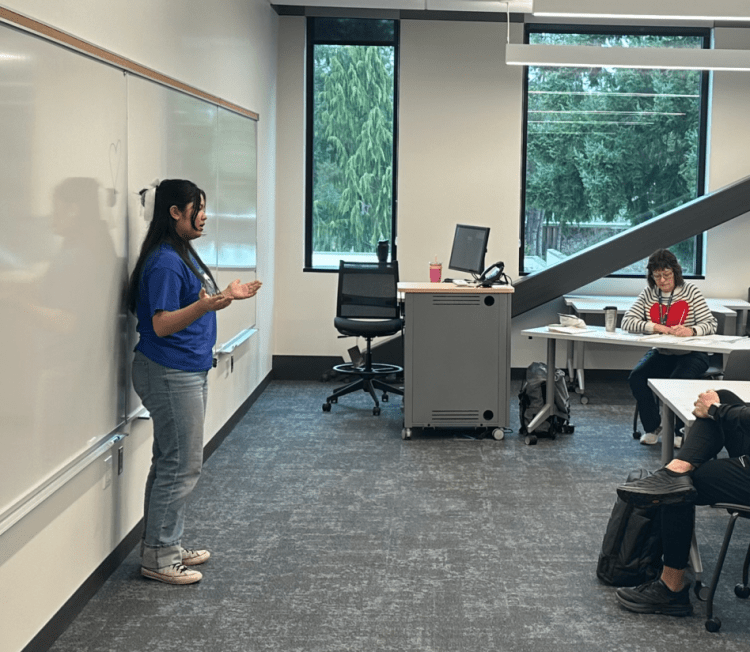
Description / Regulations
Ten minutes maximum (no minimum length). Using a play, short story, or other published work, students perform a selection of one or more portions of a piece up to ten minutes in length. With a spotlight on character development and depth, Dramatic Interpretation focuses on a student’s ability to convey emotion through the use of a dramatic text. Competitors may portray one or multiple characters. No props or costumes may be used. Performances may also include an introduction written by the student to contextualize the performance and state the title and author.
Selections must be cuttings from published printed novels, short stories, plays, or poetry. Monologues are acceptable. A cutting must be from a single source. During the presentation the contestant must name the author and source from which the cutting was made.
The presentation is memorized and no book or manuscript may be read in the performance. No physical objects or costumes may be used. Actors will utilize stationary blocking to enhance the interpretation. They may take a single step in any direction as long as they stay within an imaginary 3′ x 3′ box during the entire interpretation.
Dramatic Interpretation, contrary to its name, is not all about drama. While dramatic elements are key aspects of the event, melodramatic, or overly-sad selections are not ideal choices for performance. DI lacks props, costuming, sets, and other luxuries seen in various forms of performance art. There is a set time limit of ten minutes, with a thirty second grace period. Students who choose to compete in Dramatic Interpretation should focus on suspending the disbelief of the audience by portraying a realistic, emotional journey of a character(s). The performance should connect to the audience. Students who do Dramatic Interpretation may perform selections on topics of serious social subject matter such as coping with terminal illness; significant historical situations, events, and figures; as well as racial and gender discrimination, suppression, and oppression. Students should select pieces that are appropriate for them. Considerations for selecting a DI topic should include the student’s age, maturity, and the ethos of Lutheran Schools.
Selecting / Cutting a Competition Piece
Finding competition pieces can be one of the most difficult parts of Dramatic Interpretation. There are so many potential pieces and everyone wants to find the right one. One of the most important things to remember is for the competitor to find a piece that speaks to them. They should enjoy the piece, and it should fit their aesthetic and make sense to them. Each competitor should seek a story that’s important to THEM. Coaches may play a critical role in guiding contestants to competition pieces, but the final decision of what piece to perform should rest with the competitor.
There are billions of potential pieces out there across various types of mediums. The best pieces are always going to be found by reading. Short stories, poems, novels, children’s books, mysteries, plays, musicals, essays – all are excellent sources for Dramatic Interpretation. If new to this, though, competitors don’t need to reinvent the wheel. One might look through the variety of resources below to find something that may even have already been cut for competition. It’s okay to use a previously prepared piece, particularly for the first time competing in Dramatic Interpretation. Every piece is different for every person because each person’s unique style and personality brings it to life.
What follows is a list of sites where Dramatic Interpretation source material may be found. This is certainly not a fully comprehensive list. A competitor may pull the selection directly out of source material in one block. More often he or she will be cutting sections from various places of a single piece to tell a condensed version of the story, or to share just a significant portion thereof. On some of the sites below already prepared pieces may be found; these are eligible for use in L.E.S.T. Northwest. Keep in mind not all pieces found at these sources may be appropriate content for a Lutheran School competition.
- Open Library– This is a great site to search if you’re looking for a dramatic script. Simply type in the subject, author or title you seek and you’re bound to find something useful. Be careful though. Everything is in here, so you can get lost in all the literature. Zero in on the pieces appropriate to Dramatic Interpretation.
- Alibris– Perfect for the bargain-hunting script seeker, this inexpensive website has tons of used, new, rare, and fascinating books that could be used in competition. With 100 million titles to choose from, it will be hard not to find something worthwhile.
- The Interp Store – This site offers a large selection of pieces written specifically for speech competitors. These pieces often require a lot of personality and innovation. If you are good at characters and can bring meaning to pieces, some of these have been quite successful on the national stage.
- Green Room Press – This site also offers pieces written specifically for speech (forensic) competitions.
- Playscripts – Carries a wide range of plays perfect for forensics competitions.
- And you can find even more options with the help of Google!
Adjudication
Each competitor will be scored by one or two adjudicators. When two adjudicators are present, their scores are averaged together. Performers are given up to 100 points based upon how appropriately the individual follows the rules of DI as well as meets the standards of three performance elements: Characterization, Blocking, and Cutting. The specific scoring sheet is available by clicking the button further down this page.
As to the performance elements, the following principles apply:
Characterization: Is each character well-developed? Is each character relatable? Does a character’s response seem believable given the situation being portrayed?
Blocking: Can you tell what the performer is doing in the scene? Is it clear what character(s) they are playing? Is the movement motivated?
Cutting: Do you understand what is happening? Is the story line easy to follow? Does the sequence of events make sense?
Points_Placement
90-100: Blue Ribbon Performance
80-89: Red Ribbon Performance
70-79: White Ribbon Performance
Regarding Ribbon Levels, competitors are judged on their own performance, not compared to other performers, and all may earn as high as Blue Ribbon level. Additionally, the three highest adjudication scores in each category (5th-6th, 7th-8th) may be awarded First, Second, and Third Place awards for best performances in their categories. The adjudication sheets, with valuable comments, will be included in each school packet after the closing of L.E.S.T. Northwest.
The adjudicators’ scoring sheets, with valuable comments, will be given to each school at the closing of L.E.S.T. Northwest.
It is important that adjudicators write complete evaluations. They should not wait until the round is completed to begin writing constructive feedback. Writing during students’ presentations is permitted. It is critical for the contestants and their coaches to have the educational feedback that justifies adjudication decisions. Adjudicators must strive to be objective in their ratings, not allowing personal opinions or biases regarding an idea or selection to predetermine their impression of a student’s presentation.
Disruption – If an adjudicator feels that circumstances beyond a performer’s control seriously impaired his or her performance (for example, a fire alarm, loudspeaker announcement, etc.), the adjudicator has the option to allow the performer to begin again. Adjudicators should proctor the room to maintain a positive atmosphere.
Time Limits
All forensic events are timed. A competitor’s time should be recorded on the ballot. An introduction is considered part of the presentation and must be timed. Dramatic Interpretation performances have a 10 minute maximum length (no minimum), and include a 30 second “grace period”. If the adjudicator(s) in a round determine that a student has exceeded the maximum time and gone beyond the “grace period,” the student shall receive an automatic five (5) point deduction.
How to Participate
All teams must be pre-registered by the deadline. Registration details and deadlines are found on the Registration Page.
The Dramatic Interpretation-specific Registration Form must include the Coach’s name and email, first and last name of each participant, and title and author of source material.
 LEST Northwest