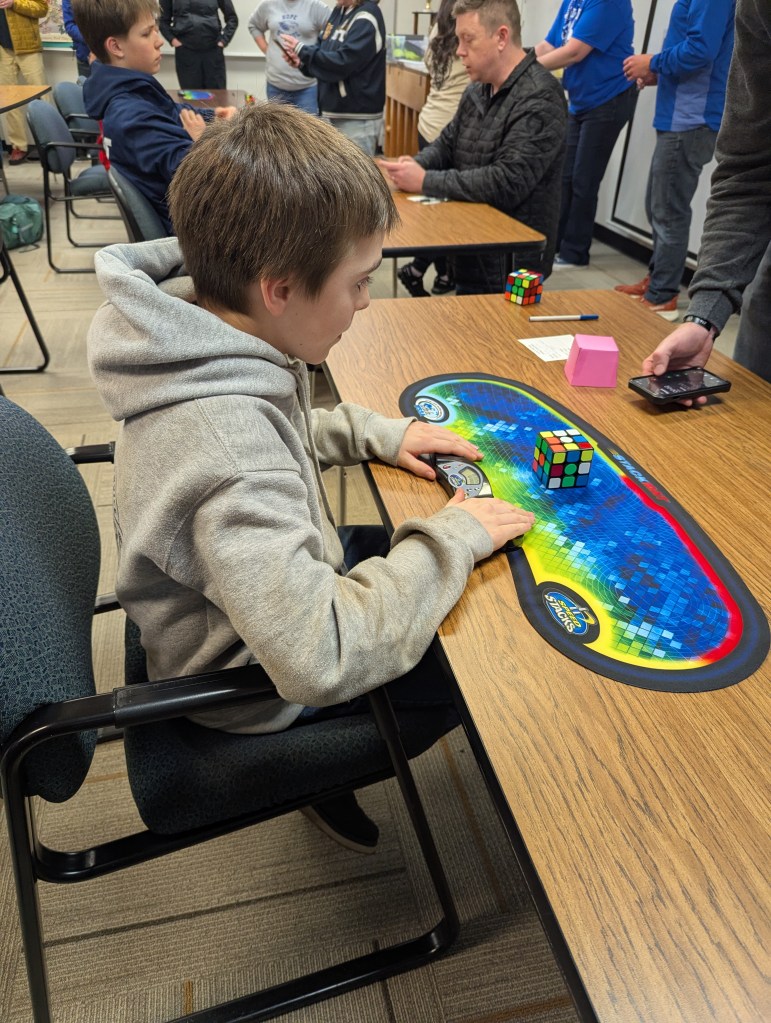
Details
The Cubing Competition will take place in a room that is large enough to accommodate the event. Spectators are welcome, but be aware that anyone over the age of 18 will need a L.E.S.T. Tournament Pass to attend. Passes may be purchased at participating schools prior to L.E.S.T. at a reduced cost (good for any spectator event across the entire tournament), or purchase a pass at full price while at L.E.S.T. A lower cost daily pass will also be available.
How to Participate
All teams must be pre-registered by the deadline. Registration details and deadlines are found on the Registration Page.
Each school may have up to four participants, no grade level restrictions. It is recommended each school also list four alternates, in the case of schedule conflicts, illness, or other reasons a registered individual cannot participate. Only pre-registered alternates will be able to step in for a competitor unable to participate.
Requirements
- All materials required for the competition will be provided by L.E.S.T. Northwest – a 3×3 Cube and a timer for use at L.E.S.T.
- You are encouraged to use alternates for any participant who may find themselves in the position of needing to decide between cubing and another L.E.S.T. event. Alternates must be pre-registered on the L.E.S.T. Registration Form due mid-December.
Guidelines
- Participants will play the ‘best of two’ 10-minute rounds of cubing where they will be responsible for unscrambling the 3×3 Rubik’s Cube given to them by the judge, so each side of the Rubik’s Cube has all colors matching, within each 10-minute round. Each participant will have 15 seconds to look at the cube before having to start the clock for their solve.
- The results of a round are measured as follows:
- All timed results under ten minutes are measured and truncated to the nearest hundredth of a second.
- If a competitor has NOT solved the puzzle within the ten-minute time frame of either of the two rounds, they are DNF (Did Not Finish).
- The result of an attempt is recorded as DNF (Did Not Finish) if the attempt is disqualified or unsolved/unfinished.
- The result of an attempt is recorded as DNS (Did Not Start) if the competitor is eligible for an attempt but declines it.
- Solved State
- Only the resting state of the puzzle, after the timer has been stopped, is considered.
- The puzzle may be in any orientation at the end of the solve.
- All parts of the puzzle must be physically attached to the puzzle and fully placed in their required positions.
- A puzzle is solved when all colored parts are reassembled, and all parts are aligned within the limits specified below:
- For every two adjacent parts (e.g. two parallel, adjacent slices of a cube) of the puzzle that are misaligned by more than the 45 degrees, the puzzle is considered to require one additional move to solve.
- If no further moves are required to bring the puzzle to its solved state, the puzzle is considered solved without penalty.
- If one move is required, the puzzle is considered solved with a time penalty (+2 seconds).
- If more than one move is required, the puzzle is considered unsolved (DNF).
- During the Solve
- The competitor must not communicate with anyone other than the judge.
- The competitor must not receive assistance from anyone or any object other than the surface they are playing on.
- The competitor may hold the puzzle against the surface to help operate the puzzle.
- Stopping the solve:
- The competitor releases the puzzle before stopping the solve and stops the solve by stopping the timer. If a stopwatch is in use, the judge stops the stopwatch as soon as the competitor does this.
- When using a stopwatch as the only timer, the competitor stops the solve by releasing the puzzle and notifying the judge that they have stopped the solve. The judge stops the stopwatch as soon as the competitor does this.
- Scoring
- The judge records the time for each round, for each competitor.
- At the discretion of the judge, a participant may be disqualified from an event for the following reasons:
- Failure to check in for the event on time.
- Distracts or interferes with others during the competition.
- Fails to abide by the rules during the event.
Awards
The judge will take the best time for each competitor to determine an individual top point award. The judge will compile the best times of the individual school’s participants to determine the lowest overall composite time for 1st-3rd Place.
 LEST Northwest