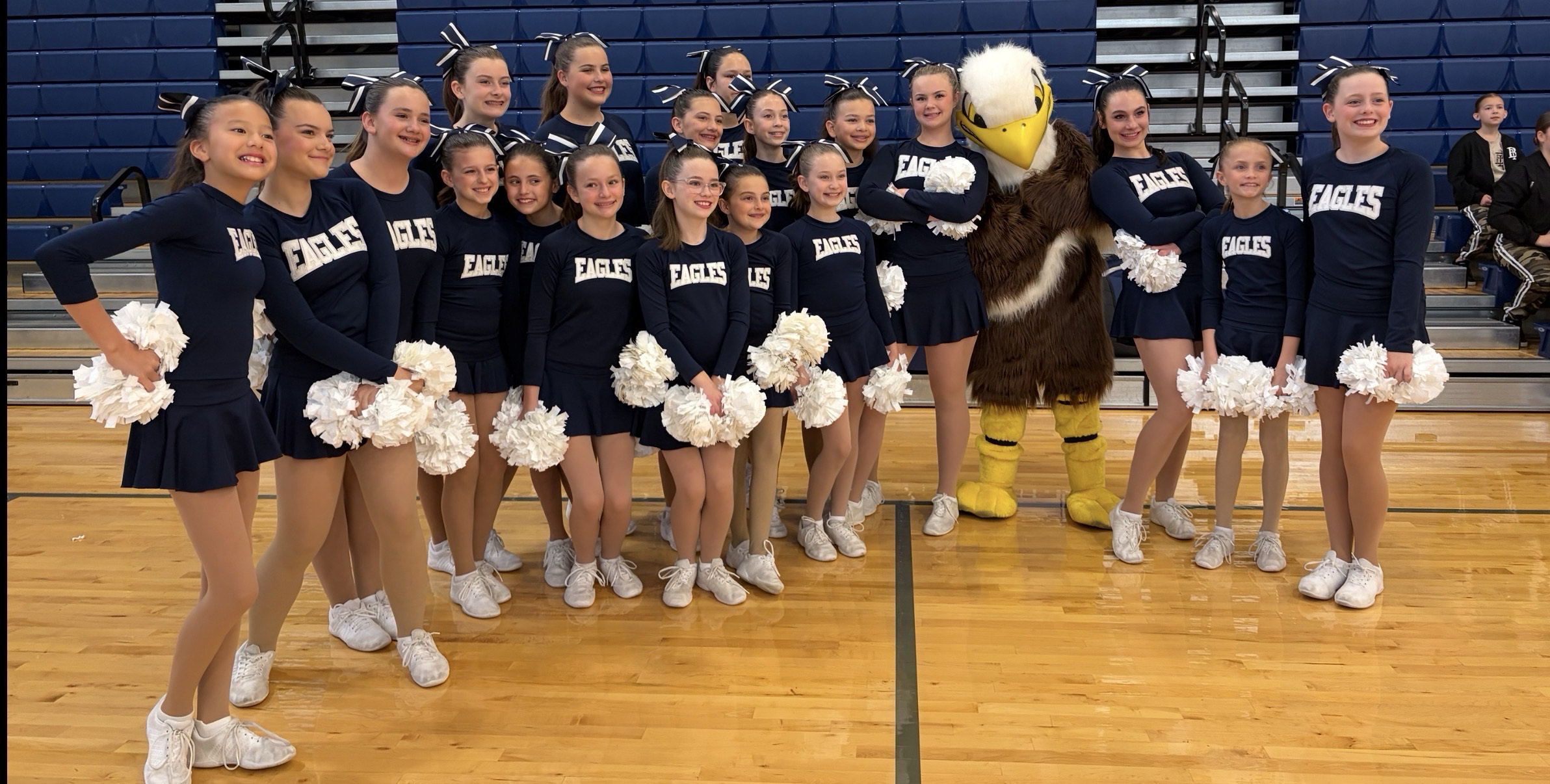
Description/Regulations
The Cheerleading Competition is conducted with two divisions, divided entirely by the size of the squad:
“A” = 14 or less students
“AA” = More than 14 students
Squads are comprised of 5th−8th grade students (male or female), one squad allowed per school. Team trophies will be awarded to the highest scoring teams. The number of awards will depend on the number of entrants in each division. L.E.S.T. Northwest may also provide outstanding performance awards for individual or group demonstrations.
SQUADS MUST BE DULY CONSTITUTED BY THEIR RESPECTIVE SCHOOLS with an advisor in attendance. They must also have been in existence through their school’s basketball season, cheering at home and/or away games. No school may have more than one Cheerleading squad competing at L.E.S.T. Northwest.
Schedule
The individual cheerleading squads are encouraged to cheer at their school’s basketball games throughout the tournament. The L.E.S.T. Cheerleading Competition date and time will be placed on the L.E.S.T. Master Schedule. It will run in conjunction with the Dance Competition. Schools that have a dance team and a cheerleading squad will be properly spaced so that no school will have their cheerleading squad perform right before or right after their dance team.
Even though the two competitions are run simultaneously, they are judged separately and on different criteria. Please pay close attention to the adjudication forms for the respective competitions. Scoring is based on the fundamental skills listed on the adjudication forms. The adjudicator’s scoring criteria for Cheerleading is available by clicking the button further down this webpage.
A performance schedule for the Cheerleading and Dance Competitions will be posted on the L.E.S.T. Northwest website by early February.
How to Participate
- All teams must be pre-registered by the deadline. Registration details and deadlines are found on the Registration Page.
- Each cheer team is required to submit an in-order outline of their routine with a list of all stunts, stacks, dismounts, and tumbling that they plan to use for their L.E.S.T. Northwest routine. Please include photocopies of the pages in the NFHS Spirit Rules Book where these stacks / stunts / dismounts / tumbling are shown to be legal. This outline must be received no later than January 14, 2027. Squads may eliminate stunts that they cannot perfect by the L.E.S.T. but will not be allowed to add any new ones. Please send a list of any deleted items by the end of January. The Adjudicators will use these outlines as part of their scoring tools. Each participating school should refer to the NFHS website for the National Federation of High Schools Spirit Rules Book: http://www.nfhs.com/searchadv.aspx?IsSubmit=true&SearchTerm=spirit
- All music must be properly registered on the Cheer Registration form, listing song, artists, album, and recording label for each piece of music. This is due to copyright laws. The use of Christian music is strongly encouraged. No music with inappropriate language or themes will be allowed, even if lyrics have been edited out.
- Teams must submit a thumb drive of their music for competition at the announcer’s table prior to the start of the Dance/Drill/Cheer Competition. Exact date, time, and location can be found on the Master Schedule prior to the tournament. Teams must label their music with team name, school name, city, and coach’s name, and bring an extra copy of the music to the competition. A team representative must come to the announcer’s table when it is the team’s turn to perform, to tell when to start and stop the music. In the event of technical difficulties, you may have one music restart. Please check to be sure the music will play on the music system before competition.
- Any team failing to submit proper, completed documentation by scheduled date or time may be eliminated from the competition.
- A maximum of 20 cheerleaders may be on the floor at any given time.
- NO jewelry of any kind may be worn during competition. Medical Alerts are not jewelry and may be worn, but must be taped against the body under the uniform or tied or taped to a shoelace.
- Fingernails must be short (not to extend past the end of the fingertip) and must be unpolished. In the event of a medical emergency this helps medical personnel more easily acquire an accurate blood oxygen level.
- Hair longer than collar length must be pulled into a ponytail/braid if the team will be performing any stunts. No big or hard barrettes may be worn. Hair ribbons must not reach past the outside corner of the participant’s eye.
- No loose glitter may be worn. Frosted makeup is acceptable.
- No bare midriffs. Uniform top must meet the top of the skirt/bottom when standing.
- Shoes must be worn at all times. No bare or stocking feet.
- Squads must be duly constituted by their respective schools with an Adviser/Coach in attendance. Only students that have cheered for regular season games may compete at the L.E.S.T. Northwest.
- No school may have more than one cheerleading team competing in this competition.
- Competition routines are to be no more than three (3) minutes in length. No more than half of the routine may be performed to music. Teams that exceed the total time limit will receive a 10 point deduction. Teams who have more than half of their routine to music will receive a five (5) point deduction.
- All routines must have at least one chant/sideline cheer and one floor/crowd participation cheer. Leading the crowd will increase your score.
- We will have two timers at the competition. One will be seated near the adjudicators and the other will be near or on the floor. Time starts with the first note of music or the first organized motion/movement. Teams may place mats, poms, or signs before they begin (after they have been told to do so by the deck monitor). Teams may “Rally” onto the floor (taking no more than 10 seconds) without the official time starting. Time ends when the last team member has cleared the court line completely. Teams will receive a deduction if either timer records a time violation.
- A 10 point deduction may be taken for improper/illegal stunts/dismounts, non-submitted stunts/dismounts, or for lack of proper spotting.
- Teams must report to all scheduled areas on time. Any team not in place when called may be eliminated from the competition.
- All stunts must be performed on mats. Mats must be supplied by the cheer squad. Note: If traveling prohibits your school from bringing your own mats, Cheerleading squads must make alternate arrangements with another school to use their mats. They may consider contacting Concordia Christian Academy to borrow theirs. You are responsible for placing and removing the mats for your performance.
- For any Cheerleading Competition questions, please contact the L.E.S.T. Northwest Coordinator – Mary Schuldheisz at 503-703-6675 (cell/text) or by email at lestnorthwest@gmail.com.
Adjudicators / Timers
There will be both Standard Adjudicators and Technical Adjudicators for the Cheerleading Competition. Adjudicators will be seated in one section of the gym. The L.E.S.T. Coordinator will inform competitors as to where the adjudicators will be seated in the gym before the L.E.S.T. begins. There will be two timers for the competition. One timer will be seated with the adjudicators, and one will be on or near the floor. If either timer finds a timing violation, a time violation will be taken.
Cheerleading Adjudication Criteria
CROWD PARTICIPATION
- Team gives the crowd easily understandable directions using a strong, clear voice.
- Team may demonstrate desired motions/actions as needed.
- Team ensures the crowd understands when to start, how many times to repeat, and when to stop.
SHOWMANSHIP
- Team shows enthusiasm and confidence by using good smiles and facial expressions.
- Team maintains a constant high level of spirit throughout the performance. Team does not fade at the end.
- Team uniform and personal physical appearance are neat, clean, and appropriate.
- Team shows a command of all physical aspects of their program.
- Team is able to recover and continue after a problem in their routine.
- Team maintains good eye contact with their crowd.
- Team performs only appropriate and non-suggestive moves as part of their program.
SYNCHRONIZATION
Good Variety
- Team performs three or more types of synchronization (i.e. arms, legs, tumbling, formation changes, etc.).
Solid Cheers
- Team uses synchronization within the body of a cheer.
Good Timing
- Team performs in a manner that clearly shows the intended use of synchronization in motions, steps, etc.
- Team’s synchronized movements are even and consistent throughout performance.
- Team’s synchronized motions/movements are sharply defined and executed.
EXECUTION
Smooth Transitions
- Team moves confidently from one area to the next without long pauses, trips, bumps, or mistakes in positioning.
- Team performs a program that moves smoothly from one section to the next.
Sharp Motions
- Team executes their motions using precise angles, accurate timing, tight arms and legs, and good body positioning.
Clean Formations
- Team executes their formations using clean lines, even spacing (where appropriate), and a good use of the floor.
- Team’s formations are easily understandable and appropriate to the cheer.
- Team uses mats under stunt formations where appropriate.
Precision / Definite Arms and Legs
- Team’s motions ‘hit’ at the same time.
- Team’s arms and legs are not swung from one motion to the next but moved in an intentional manner to achieve precise positioning.
- Shoulders are down and arms are at the proper angle in relationship to the body.
- Feet and legs are tight and toes are POINTED during jumps (No Flexed Feet).
VOICE
Strong Voice
- Team projects words in an easily understandable tone. The use of the lower “chest” voice is encouraged.
- Team does not yell in a high “screechy” voice.
Good Volume
- Team uses loud voices that can be clearly heard.
- Team uses changes of volume where appropriate.
Spoke Clearly
- Team speaks/yells in a manner that allows them to be clearly understood.
- Team does not use a sing-song tone.
JUMPS
Good Height
- All team jumps achieve the same height at the top of the jump.
- All individual jumps achieve at least the height of the waist of the jumper.
Variety of Jumps
- Three or more different jumps must be done during the competition routine to constitute a variety of jumps.
- More than one cheerleader must do the jumps.
Degree of Difficulty
- Box 1 – Tuck, Jump, Spread Eagle
- Box 2 – Double Hook, Hurdler (any), Herkie
- Box 3 – Toe Touch, Pike, Double Nine or two or more consecutive jumps done with no prep in between
STUNTS
Solid Stunts
- Teams must show a proficiency of achieving their stunt with a solid mount, lift, and settle of the flier.
- Teams must have a proper number of bases and spotters for a stunt.
Clean Dismounts
- The flier must keep their body tight with toes pointed and no flailing of the arms.
- Bases must toss and catch and/or follow and support the flier all the way to a standing position on the floor or to a prep position of a following stunt.
- Spotters must maintain constant eye contact with their flier at all times.
- All stunts performed at dismount (twists to cradle, forward suspended roll, etc.) must have proper spotting in place and achieve full rotation.
Variety
- Use of two or more different stunts is needed to count as a variety.
- Partner stunts may only be used as more than one stunt if more than two stunts are performed.
TUMBLING
Good Variety
- Teams must use two or more types of tumbling (i.e. somersault and cartwheel) or –
- Individual and synchronized tumbling
Good Use of Skills
- Performers use only skills with which they are confident and proficient.
- Skills are incorporated into cheers, dance, or performed as opening to routine.
Effective
- Skills hit on the down beat of music/sound effect.
- Skills achieve synchronized air positions and landings.
- Skills enhance/encourage crowd participation/response during a cheer.
Cheerleading Stunting Rules
- All stunts above the waist must be performed on a matted surface. Cheerleading squads must provide their own mats, or make arrangements with another school to utilize their mats. Schools may consider contacting the local host school, Concordia Christian Academy, to borrow theirs. You will be responsible for mat placement and removal.
- All stunts above the waist must have a separate head and shoulders spotter.
- The spotters’ attention shall never leave their flier for the duration of the stunt.
- All extended stunts must have a separate head and shoulders spotter. The use of a second/front spotter is strongly encouraged.
- No inverted stunts may be performed with the exception of a forward suspended roll. The flier shall remain in constant hand to hand contact with their bases at all times for this stunt.
- Teams may only perform stunts for which they have adequate skills and proficiency. A deduction of up to 10 points may be taken for a failed or fallen stunt.
- A deduction will be taken for each non-registered stunt/stack/dismount/tumbling move.
- No stunts may be performed over any person or prop.
- The flier may not carry any prop into any stunt. All props must be handed to top once the flier is in position.
- A safety violation deduction may be taken for any prop or uniform part that is stepped on during any part of the performance.
- The only props allowed are pompons, megaphones, and signate (poster board size and smaller).
Each participating school should refer to the web site for the National Federation of High Schools (NFHS) Spirit Rules Book. This rules book can be purchased by going to: http://www.nfhs.com/c-229-spirit.aspx
Score Sheets and Awards
Teams will receive their score sheets when the awards are presented at the conclusion of the Dance/Drill/Cheer Competition or in the school packet at the conclusion of L.E.S.T. at the Awards Ceremony.
 LEST Northwest